

You’ve probably seen “ID” pop up in your chats and wondered what it means. It can mean a few things. In text slang, many people use it as a short form of “I’d,” like “I’d love to.” Others use it to mean identification, like an ID card. The meaning changes with the sentence.
Most of the time, ID is friendly and simple. It saves time and keeps your texts short. But it can also confuse people. Some mix it up with “IDK,” and a wrong guess can cause an awkward chat. In this guide, you will learn 4 good uses and 2 bad ones, so you can text with confidence.
What Does ID Mean in Text?
Quick answer: In most chats, “id” is a lazy way of typing “I’d”, meaning “I would” or “I had.” In other messages, ID means identification (an ID card or an account name).
Because people skip the apostrophe when typing fast, the two meanings look identical. Context is your only clue.
Here are the four meanings you will actually run into.
1. “I’d” (Most Common Meaning in Chats)
This is the one you will see 90% of the time. “I’d” is short for:
- I would: “id say yes”
- I had: “id already left”
- I should / I’d better: “id better go”
Typing “id” instead of “I’d” is a texting habit, not a new slang word. It saves a keystroke, and phones often autocorrect it anyway.
Examples:
- “id love to come tonight”
- “id rather stay home”
- “id never say that to her”
2. “ID” as Identification
Here ID is a proper abbreviation. It usually means:
- A government ID card or passport
- A student or work ID
- A user ID or username on an app or game
Examples:
- “Bring your ID to the exam hall.”
- “What’s your Instagram ID?”
- “I forgot my ID at home.”
Notice that this version is normally written in capital letters. That helps a lot.
3. “IDK” Confusion (Common Misunderstanding)
Some people think ID alone means “I don’t know.” It does not. That is IDK.
The confusion happens because ID is the first part of a whole family of abbreviations:
| Abbreviation | Meaning |
|---|---|
| IDK | I don’t know |
| IDC | I don’t care |
| IDGAF | I don’t give a f***, so use with care |
| IDM | I don’t mind |
| IDEK | I don’t even know |
If someone writes only “id” with no extra letters, they almost certainly mean “I’d.” Don’t read a missing “K” into it.
4. Rare Usage: “ID” as “Identify”
Sometimes ID is used as a verb. Think of someone asking you to “ID” a song, a plant, or a person in a photo.
Examples:
- “Can anyone ID this song?”
- “Help me ID this bug on my wall.”
You see this on Reddit threads, gaming chats, and music groups. It means “help me identify this.” It is useful, but not very common in everyday texting.
ID Meaning in Law
In law, “Id.” is short for the Latin word “idem,” which means “the same.” Writers use it in legal citations. It points to the source named just before it. This saves time and avoids repeating long case names or book titles. For example, if one citation follows another from the same source, a writer can simply put “Id.” with the page number.
ID Meaning in Chat in Urdu
If you chat in Urdu or Roman Urdu, this is how the meanings translate.
| English | Urdu meaning | Roman Urdu |
|---|---|---|
| I’d (I would) | میں کروں گا / میں چاہوں گا | main karunga / main chahunga |
| ID card | شناختی کارڈ | shanakhti card |
| Social media ID | اکاؤنٹ / آئی ڈی | account / ID |
In Pakistani chats, “ID” very often means a social media account. When someone says “apni ID bhejo,” they are asking for your Instagram, Snapchat, or Facebook username, not your ID card.
So the same word can mean “my account,” “my identity card,” or “I would,” depending on who is talking.
See also:MM Meaning in Text: 3 Good Signs & 3 Red Flags
Where Is ID Used?
You will spot it on almost every platform. The meaning shifts a little from place to place.
1. Social Media Platforms
On Instagram, TikTok, and Snapchat, people use ID mainly for account names (“drop your ID”) and casually for I’d (“id post that”).
2. Text Messaging (SMS & WhatsApp)
Here it is almost always the lazy I’d. Fast typing, no apostrophe, no problem.
3. School or Work Communication
In these settings, ID means identification: student ID, employee ID, ID badge. Slang is rare, and “id” without an apostrophe can look careless.
4. Gaming Communities
Gamers use player ID or game ID all the time. “Add my ID” means “add my in-game username.” It can also mean “identify” (“ID that enemy”).
5. General Internet Slang Culture
On forums and comment sections, ID can mean any of the above. Readers just guess from the topic. That is why slang guides like this one exist.
ID Meaning in Text on Instagram
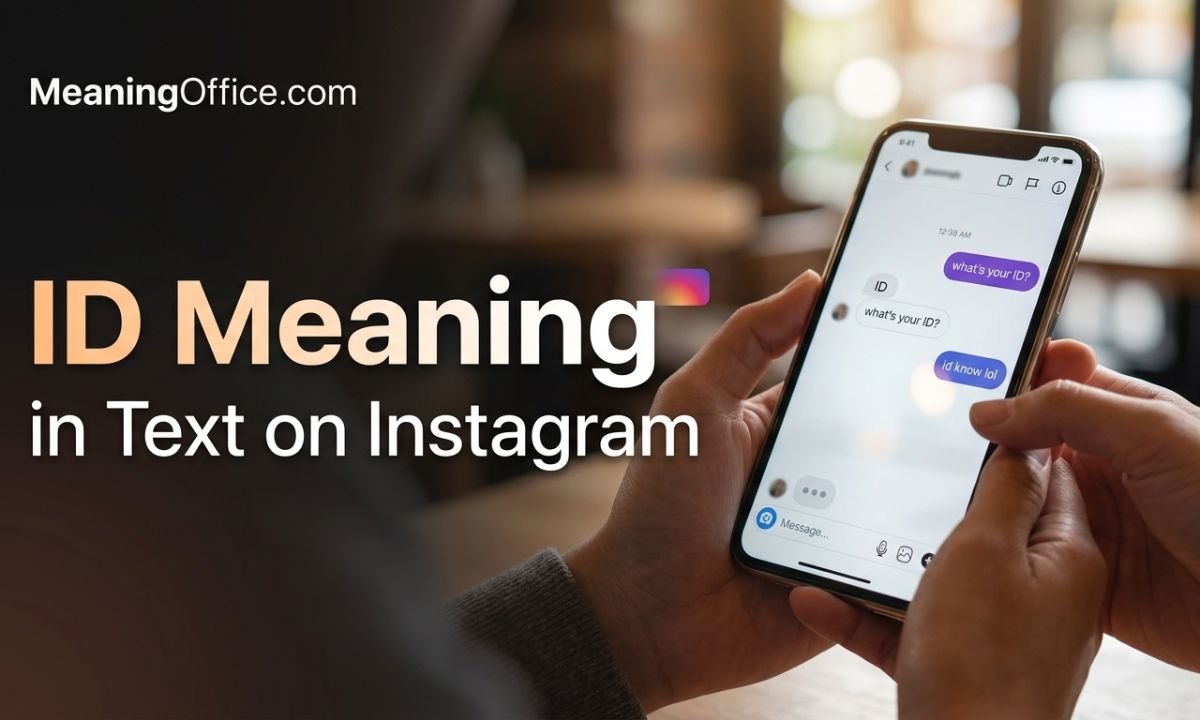
On Instagram, ID is most often tied to your username.
- “Send your ID” = send your Instagram handle.
- “Is this your main ID?” = is this your primary account?
- “Check my other ID” = look at my second account.
In comments and DMs, though, “id” can still just be “I’d.” Example: “id wear this on a date.” Look at the sentence before deciding.
Examples of ID in Conversation
Real examples make this much easier. Here are short chats across different moods.
Friendly Chat Examples
A: Are you coming to the match?
B: id love to, but I have a test.
A: What should I order?
B: id go for the burger.
Casual/Funny Examples
A: Should I text my ex?
B: id rather eat a lemon.
A: Would you eat that spicy challenge?
B: id regret it in five minutes, but yes.
Flirty Examples
A: Would you go on a date with me?
B: id say yes 😉
A: You free tonight?
B: for you, id make time.
Everyday Chat Examples
A: Did you tell him?
B: id already told him yesterday.
A: Can you share your game ID?
B: sure, adding you now.
Formal Context Examples (ID = Identification)
- “Please attach a copy of your ID with the form.”
- “Visitors must show a valid photo ID at the gate.”
- “Enter your employee ID to log in.”
I’d Meaning in Chat from a Girl
Girls and guys use “id” the same way, but the tone can carry extra meaning.
| What she says | What it usually means |
|---|---|
| “id love to” | She is interested and says yes |
| “id say maybe” | She is unsure, not a firm yes |
| “id rather not” | A polite no |
| “id think about it” | She wants time and is not committing |
| “id miss you” | A warm, affectionate message |
Don’t treat any single word as a signal. Her emojis, reply speed, and the rest of the chat tell you far more than “id” alone.
ID Meaning in Text on Snapchat
Snapchat uses ID in two ways:
- Snapchat ID: your username. “What’s your snap ID?”
- “I’d” in captions: quick, fun statements like “id be there in a second.”
Snapchat messages vanish quickly, so people type fast and skip punctuation. That makes “id” extra common there.
4 Good Uses of ID in Text
Here are the situations where using ID works well.
- Showing a polite preference. “id pick the blue one” sounds soft and friendly.
- Accepting an invite. “id love to join” is warm and clear.
- Giving light advice. “id wait a day before replying” feels kinder than “you should.”
- Sharing an account name for connection. “Add my ID” is simple in gaming and social apps.
2 Bad Uses of ID in Text
And here are the two places it tends to go wrong.
- Writing “id” without the apostrophe in formal messages. In emails to teachers, bosses, or clients, it reads as sloppy. Use “I’d.”
- Sharing your real ID with strangers. If someone asks for your “ID” and means a card, photo ID, or CNIC, be careful. Never send identity documents in a casual chat. Scammers use this trick often.
When to Use and When Not To Use ID Meaning in Text
When to Use It
- In relaxed chats with friends and family
- On Snapchat, WhatsApp, and Instagram DMs
- When you are typing fast and the meaning is obvious
- When asking for or sharing a username in a game
When Not to Use It
- In school assignments, applications, or work emails
- When the message could be confused with “ID card”
- When talking to someone who is not used to slang
- When anyone asks for your personal identification online
Why Context Matters
“id” can be a verb contraction, a card, a username, or a request to identify something. Three habits help:
- Look at the capital letters. “ID” is usually identification; “id” is usually “I’d.”
- Read the next word. “id love,” “id say,” and “id rather” are all “I’d” forms.
- Check the platform. Gaming and social apps lean toward usernames.
Similar Slang Words or Alternatives
If you want other ways to say the same thing, these are close cousins.
1. I’d
The proper form. Use it in anything semi-formal. It is also what “id” is trying to be.
2. IDK
“I don’t know.” Casual and very common. Not the same as ID.
3. IMO
“In my opinion.” Use it when you want to share a view softly, like “IMO, the second one looks better.”
4. BRB
“Be right back.” Tells your friend you will return to the chat soon.
5. TTYL
“Talk to you later.” A friendly goodbye in text.
| Slang | Meaning | Tone |
|---|---|---|
| I’d / id | I would, I had | Casual to neutral |
| IDK | I don’t know | Casual |
| IMO | In my opinion | Neutral |
| BRB | Be right back | Casual |
| TTYL | Talk to you later | Friendly |
See also:YNS Meaning in Text: 3 Good Signs & 3 Red Flags
FAQs
What does ID mean in text?
Most often it is a quick way to type “I’d,” meaning “I would” or “I had.” It can also mean identification.
Is ID the same as IDK?
No. IDK means “I don’t know.” ID alone does not carry that meaning.
What does “id love to” mean?
It means “I would love to.” It is a warm yes to an invite or idea.
What does ID mean on Instagram?
Usually your username or account. “Send your ID” means “send your handle.”
What does ID mean on Snapchat?
It can mean your Snapchat username, or just “I’d” in a casual message.
What does ID mean in Urdu chat?
It can mean “main karunga” for I’d, or “shanakhti card” and “account” for identification.
Is it okay to use “id” in a formal email?
No. Write “I’d” or “I would” in formal writing. Save the short form for friends.
Is it safe to send my ID in a chat?
Not with strangers. Never share ID cards, CNIC numbers, or passports in casual chats.
Conclusion
ID is a small word with a few meanings. Most people use it to say “I’d” or to talk about an ID card. It works well in friendly chats, plans, and quick replies. The 4 good uses show how simple and handy it can be.
The 2 bad uses are easy to avoid. Don’t use ID when the meaning is not clear. Don’t mix it up with IDK, because that can confuse people. When in doubt, write the full words. A clear text always beats a quick one.