

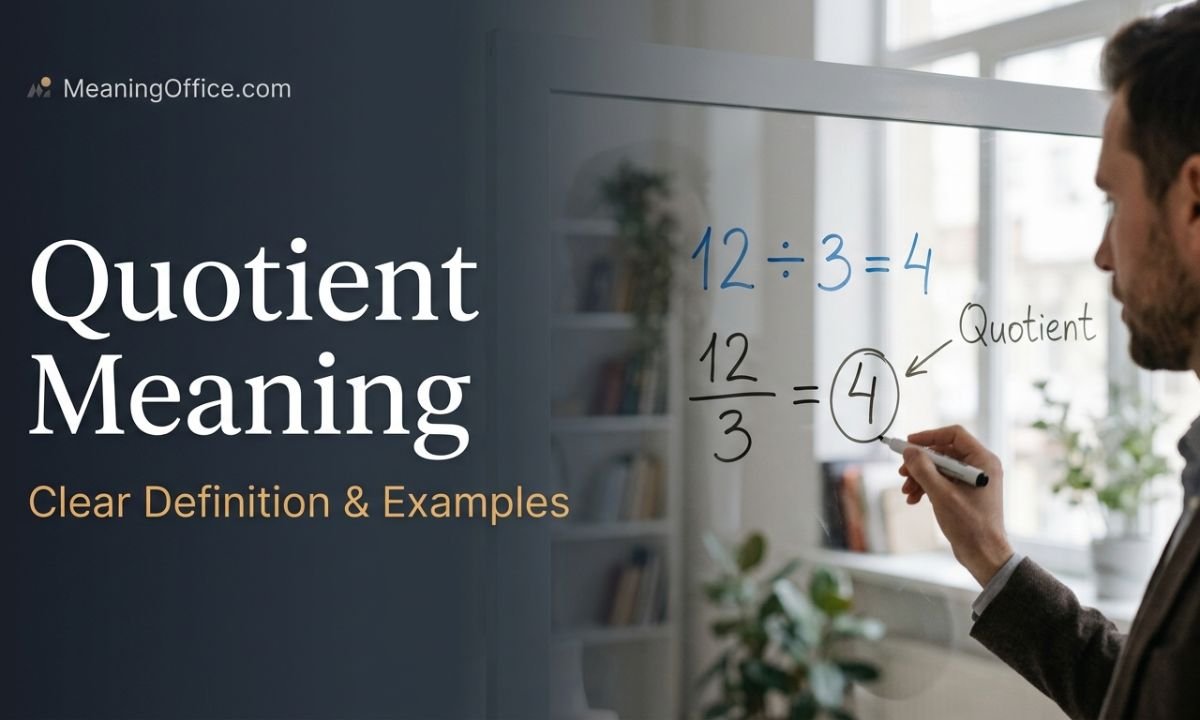
You have probably seen the word “quotient” on a math worksheet or in a word problem. It sounds formal, but the idea is simple. This guide explains what quotient means, how it works in division, and how to find it, with easy examples along the way.
Quick Answer
A quotient is the answer you get when you divide one number by another. In 20 ÷ 4 = 5, the quotient is 5.
What Does Quotient Mean?
Quotient means the result of a division problem. When you split a number into equal parts or equal groups, the number of items in each part, or the number of parts you can make, is the quotient.
The word is not slang or a text abbreviation. It is a standard math term used in schools, textbooks, and exams.
Quotient Full Form and Definition
Quotient has no full form. It is a regular English word, not an acronym.
Definition: The quotient is the number you get after dividing the dividend by the divisor.
The word comes from the Latin quotiens, which means “how many times.” That origin explains the idea well. The quotient tells you how many times one number fits into another.
What Does Quotient Stand For?
Quotient does not “stand for” anything. People sometimes ask this because they assume it is shorthand, like “LOL” or “BRB.” It is not. The word simply names the answer to a division problem.
The Four Parts of a Division Problem
Every division problem can have up to four parts. Knowing each one makes the word “quotient” much easier to remember.
1. Dividend
The dividend is the number being divided. In 20 ÷ 4, the dividend is 20.
2. Divisor
The divisor is the number you divide by. In 20 ÷ 4, the divisor is 4.
3. Quotient
The quotient is the result of the division. In 20 ÷ 4 = 5, the quotient is 5.
4. Remainder
The remainder is what is left over when the numbers do not divide evenly. In 17 ÷ 3, the quotient is 5 and the remainder is 2.
Quotient Meaning With Simple Examples

Here are a few everyday situations that show what a quotient looks like.
Example 1: Sharing Candy
You have 24 candies to share equally among 6 friends.
24 ÷ 6 = 4
The quotient is 4. Each friend gets 4 candies.
Example 2: Dividing Money
Five people win $120 together and split it evenly.
120 ÷ 5 = 24
The quotient is 24. Each person gets $24.
Example 3: Classroom Groups
A teacher has 30 students and wants groups of 5.
30 ÷ 5 = 6
The quotient is 6. There will be 6 groups.
Quotient Meaning With a Remainder
Not every division comes out even. When something is left over, the quotient is the whole number of full groups, and the leftover amount is the remainder.
Example: 47 ÷ 6
- 6 goes into 47 seven times (6 × 7 = 42)
- 47 − 42 = 5 is left over
So the quotient is 7 and the remainder is 5. You can write this as 7 R5.
Quick check: (Quotient × Divisor) + Remainder = Dividend. Here, (7 × 6) + 5 = 47.
Quotient Meaning in Fractions
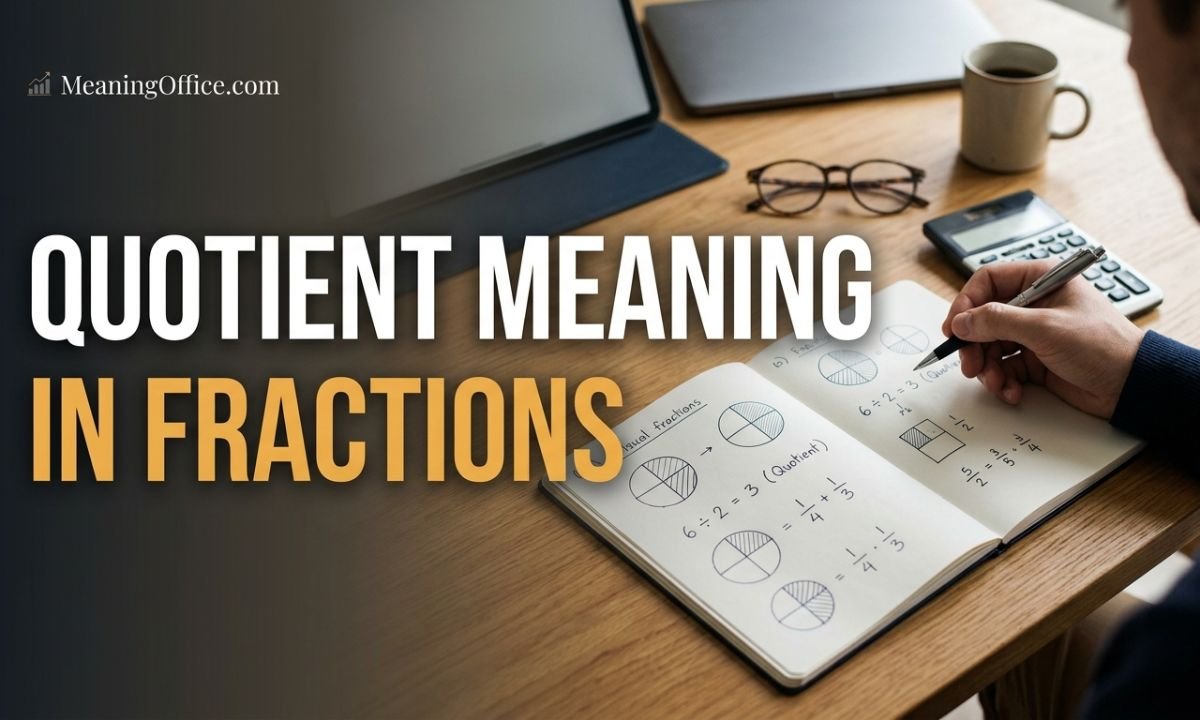
A fraction is just a division problem written another way. The fraction 3/4 means 3 ÷ 4, and its value, 0.75, is the quotient.
This is why you will often hear that “a fraction is a quotient.” The top number is the dividend, and the bottom number is the divisor. It also shows that a quotient does not have to be a whole number.
Quotient Meaning in Algebra
In algebra, the quotient can be an expression instead of a plain number.
- 12x ÷ 4 = 3x
- (x² + 5x + 6) ÷ (x + 2) = x + 3
You can check the second one by multiplying back: (x + 2)(x + 3) gives x² + 5x + 6. The idea is the same as in basic arithmetic. Only the numbers have changed into expressions.
Later in math, you will also meet the quotient rule in calculus and the difference quotient. Both build on this same idea of dividing one quantity by another.
See also:MBB Meaning in Texts Explained Clearly (2026)
Is Quotient a Slang Term?
No. Quotient is not slang, and it is not a texting abbreviation. It is a formal word used in math and, in a few cases, in everyday phrases like “intelligence quotient” (IQ). If you saw it in a chat or comment, the person almost certainly meant the result of a division.
Where Is the Word Quotient Commonly Used?
You will find “quotient” in these places:
- School math: division, long division, fractions, and word problems
- Algebra and calculus: polynomial division, the quotient rule, difference quotient
- Science and statistics: ratios and rates, such as speed or density
- Psychology: phrases like intelligence quotient (IQ) and emotional quotient (EQ)
- Business and finance: ratios used to compare numbers, such as profit margins
Quotient vs. Dividend vs. Divisor
These three terms sit in the same equation, so they are easy to mix up.
| Term | What It Means | In 36 ÷ 9 = 4 |
|---|---|---|
| Dividend | The number being divided | 36 |
| Divisor | The number you divide by | 9 |
| Quotient | The answer to the division | 4 |
A simple memory trick: the divisor is the doer, because it does the dividing. The quotient is the question’s answer.
Quotient vs. Product
The product is the result of multiplication. The quotient is the result of division.
- 12 × 4 = 48, so the product is 48
- 12 ÷ 4 = 3, so the quotient is 3
Quotient vs. Difference
The difference is the result of subtraction. The quotient comes from division.
- 12 − 4 = 8, so the difference is 8
- 12 ÷ 4 = 3, so the quotient is 3
If a question says “find the quotient of 12 and 4,” divide. Do not subtract or multiply.
Real Life Examples of Quotient
You use quotients all the time, even if you never say the word.
Sharing Food
A pizza has 18 slices and 3 people want equal shares. 18 ÷ 3 = 6, so the quotient is 6 slices each.
Organizing Books
You have 85 books to place on 5 shelves. 85 ÷ 5 = 17, so the quotient is 17 books per shelf.
Splitting a Bill
Four friends share a dinner bill of $86. 86 ÷ 4 = 21.5, so the quotient is $21.50 each.
Packing Items
You need to pack 50 items into boxes that hold 8 each. 50 ÷ 8 = 6 remainder 2. The quotient is 6 full boxes, with 2 items left over.
How to Find the Quotient
Follow these four steps for any division problem.
Step 1: Identify the Dividend
Find the number being divided. For “72 divided by 9,” the dividend is 72.
Step 2: Identify the Divisor
Find the number you are dividing by. Here, the divisor is 9.
Step 3: Divide
Ask how many times 9 fits into 72. Since 9 × 8 = 72, the answer is 8.
Step 4: Identify the Quotient
The result of your division is the quotient. So 72 ÷ 9 = 8, and the quotient is 8.
If there is a remainder, write it separately, and check your work with the formula (Quotient × Divisor) + Remainder = Dividend.
Common Mistakes About Quotient Meaning

Mistake 1: Thinking Quotient Means the Dividend
The dividend is the number you start with. The quotient is what you end up with. In 40 ÷ 5 = 8, the dividend is 40 and the quotient is 8.
Mistake 2: Confusing Quotient With Remainder
These are two separate parts. In 29 ÷ 4, the quotient is 7 and the remainder is 1. The remainder is only the leftover piece.
Mistake 3: Treating Quotient as an Abbreviation
Quotient is a full word, not shorthand. There is nothing to “spell out” or decode.
Mistake 4: Assuming Every Quotient Is a Whole Number
Many quotients are decimals or fractions. For example, 5 ÷ 2 = 2.5. Also, a quotient can be smaller than the dividend (10 ÷ 2 = 5) but it does not have to be. Dividing by a number less than 1 makes the result bigger (10 ÷ 0.5 = 20).
When Should You Use the Word Quotient?
Use “quotient” when you talk or write about the result of division. It fits best in:
- Math homework, tests, and lessons
- Explaining a calculation to a student or child
- Technical writing, reports, and data work
In casual talk, most people just say “the answer” or “the result.” Both work, but “quotient” is more precise.
Why Is the Quotient Important?
The quotient shows up whenever you need to share, compare, or measure something fairly. It helps you:
- Split things into equal parts
- Work out rates, such as miles per hour or price per item
- Understand fractions and ratios
- Build a base for algebra, geometry, and calculus
If you understand the quotient, the rest of division becomes much easier to follow.
Is Quotient Safe for Social Media?
Yes. Quotient is a neutral, educational word with no hidden or inappropriate meaning. You can use it in posts, captions, school discussions, and study groups without any concern.
Comparison Table of Related Math Terms
| Term | Operation | Meaning | Example (with 12 and 4) |
|---|---|---|---|
| Quotient | Division | Result of dividing | 12 ÷ 4 = 3 |
| Dividend | Division | Number being divided | 12 |
| Divisor | Division | Number you divide by | 4 |
| Remainder | Division | Amount left over | 13 ÷ 4 → remainder 1 |
| Product | Multiplication | Result of multiplying | 12 × 4 = 48 |
| Difference | Subtraction | Result of subtracting | 12 − 4 = 8 |
| Sum | Addition | Result of adding | 12 + 4 = 16 |
see also:Bing Chilling Meaning: Fun Uses vs Bad Habits
FAQs
What does quotient mean in simple words?
A quotient is the answer to a division problem. In 15 ÷ 3 = 5, the quotient is 5.
What is the quotient of 20 and 5?
Divide 20 by 5. The quotient is 4.
Is the quotient the same as the remainder?
No. The quotient is the main result of the division, while the remainder is the amount left over.
Can a quotient be a decimal or a fraction?
Yes. Dividing 7 by 2 gives a quotient of 3.5, which can also be written as 7/2.
What is the formula for the quotient?
Quotient = Dividend ÷ Divisor. You can check it with Dividend = (Divisor × Quotient) + Remainder.
Is quotient the same as division?
Not exactly. Division is the operation, and the quotient is the answer it produces.
Conclusion
The meaning of quotient is simple: it is the result you get when you divide one number by another. Once you know the four parts of a division problem (dividend, divisor, quotient, and remainder), the term becomes easy to spot and use. It works the same way with whole numbers, fractions, decimals, and algebra.
Next time you split a bill, share snacks, or solve a math question, you will know the answer you are looking for is the quotient.