

You get a buzz on your phone. The screen says “New SMS.” You tap it, and it’s a quick note from a friend, your bank, or a courier.
SMS is one of the most common terms in texting, yet many people don’t know exactly what it means. In this guide, you’ll learn what SMS stands for, where it’s used, how it differs from MMS and iMessage, and when to use it. There are plenty of simple examples along the way.
Quick Answer: What Does SMS Mean in Text?
SMS means “Short Message Service.” It is the standard text message you send from one phone number to another through your mobile carrier’s network. It needs no app and no internet connection.
In everyday talk, “SMS,” “text,” and “text message” mean the same thing.
Quick facts:
- Full form: Short Message Service
- Message type: plain text only
- Limit: 160 characters per message (for standard characters)
- Works on: any mobile phone with a cellular signal
- Needs internet: no
What Is the SMS Full Form?
The SMS full form is Short Message Service. The word “short” is there for a reason. Early messages were capped at 160 characters, so every word counted.
Today, longer texts are often split into parts and joined again on the other phone, so you rarely notice the limit.
What Does SMS Stand For?
In technical and everyday use, SMS stands for Short Message Service. In online slang, it can also appear with other meanings:
| Abbreviation | Meaning | Where You See It |
|---|---|---|
| SMS | Short Message Service | Phones, banks, business texts |
| SMS | Send Me Something | Jokes among friends, social posts |
| SMS | Social Media Strategy/Management | Marketing and business |
| SMS | School Management System | Education software |
The first meaning covers 99% of cases. Always check the context before assuming a slang meaning.
Is SMS Rude, Offensive, or Neutral?
SMS is a neutral term. It is a technology label, not slang with attitude. You can use it with friends, family, and coworkers.
The only exception is the joking “Send Me Something” version. Even that is usually playful, not rude.
Sent as SMS Meaning: Phone Off
You may see “Sent as SMS” under a message. This usually means your phone sent the text through the regular cellular network instead of an app-based service.
If the other person’s phone is off, an iMessage can’t reach them through the internet. Your phone may then resend it as a regular text, as long as that option is turned on in your settings. The message waits with the carrier until the phone is back on.
See also:PH Meaning in Text: 5 Easy Ways to Use It
Where Is SMS Commonly Used?
SMS is everywhere because it works on almost every phone. Here are the main places you’ll meet it.
Personal Communication
Friends and family still use SMS for quick updates, plans, and greetings. It works even when someone has no data plan or a weak connection.
Verification Codes
Many apps send a one-time password (OTP) by SMS to confirm your identity. These codes usually expire within a few minutes.
Banking Alerts
Banks use SMS to send:
- Transaction alerts
- Balance updates
- Fraud warnings
- Login confirmations
Appointment Reminders
Clinics, salons, and service centers send reminders by SMS to cut down on missed visits.
Delivery Notifications
Couriers and shops use SMS to share tracking links, delivery windows, and “your parcel has arrived” notes.
Marketing Messages
Brands send offers, discount codes, and event alerts by SMS. Open rates are high because people check texts quickly.
Real-Life Examples of SMS Usage
Here are simple examples to show how SMS looks in real conversations.
Friendly Example
“Hey! Just sending you an SMS to say good luck for tomorrow. You’ve got this!”
Warm, short, and clear.
Casual Example
“I’ll SMS you the address in a minute.”
Here, SMS works as a verb. It simply means “text you.”
Business Example
“Dear customer, your appointment is confirmed for 10 AM on Monday. Reply YES to confirm.”
Business SMS is short, direct, and often asks for a quick reply.
Security Example
“Your verification code is 482915. Do not share it with anyone.”
Never share these codes. Real companies will not ask you for them.
Social Media Example
“DM me or SMS me if you want the link.”
People use this when they want to move a chat from a public post to a private text.
Sent as SMS Meaning: iPhone to Android
An iPhone can only use iMessage with other Apple devices. When you text an Android user, your message goes out as SMS (or MMS or RCS), and it appears in a green bubble instead of a blue one.
So “Sent as SMS” on an iPhone usually means the message went to a non-Apple phone or that iMessage wasn’t available at that moment.
Origin and Background of SMS
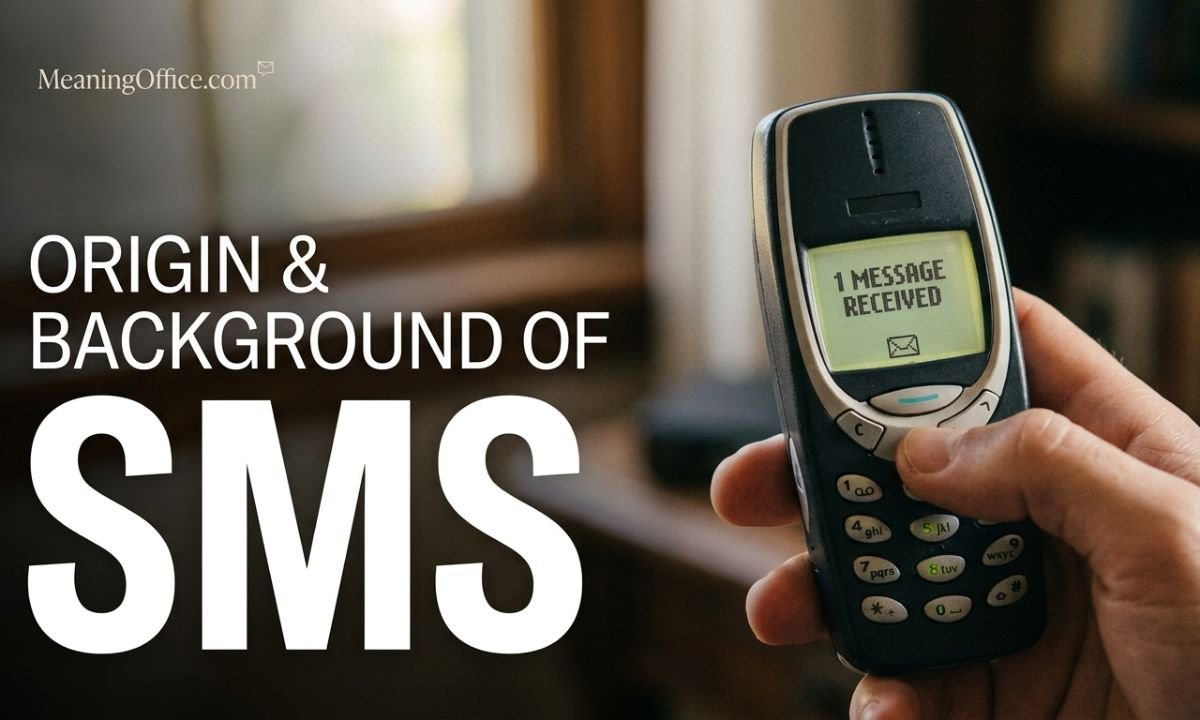
SMS began in the 1980s as part of the GSM mobile standard. The first SMS is widely credited to Neil Papworth, who sent “Merry Christmas” to a colleague’s phone in December 1992.
The 160-character limit came from early research. Its designers found that most postcard-style messages fit within about that length.
Short limits pushed people to shorten words. That is how “u,” “gr8,” “brb,” and many other text abbreviations grew popular.
SMS vs Text Message
For most people, these two are the same.
| Term | Meaning |
|---|---|
| SMS | The technical name for the service |
| Text message | The everyday name for the message |
Small catch: today, a “text” sent from your phone may travel by SMS, MMS, RCS, or iMessage. So every SMS is a text message, but not every text message is an SMS.
SMS vs MMS
MMS stands for Multimedia Messaging Service. It lets you send pictures, audio, and video.
| Feature | SMS | MMS |
|---|---|---|
| Content | Text only | Text, images, video, audio |
| Length | About 160 characters | Much longer messages |
| File size | None | Limited by carrier |
| Data needed | No | Often yes |
| Cost | Usually lower | Can cost more |
Simple rule: plain words are SMS. Words with a photo or video are MMS.
Sent as SMS Meaning: Samsung
On a Samsung phone, you might see “Sent as SMS” in the Messages app. This often appears when an RCS (chat-style) message couldn’t go through, so the phone fell back to a standard text.
It doesn’t mean something is broken. It means your message used the basic text route instead.
SMS vs iMessage and Other Chat Services
SMS runs on your carrier’s network. Chat apps run on the internet.
| Feature | SMS | iMessage | |
|---|---|---|---|
| Network | Cellular | Internet (Apple) | Internet |
| Works on all phones | Yes | Apple only | App required |
| Bubble color | Green (on iPhone) | Blue | In-app |
| Photos and video | Limited | Yes | Yes |
| Encryption | Basic | End-to-end | End-to-end |
| Needs internet | No | Yes | Yes |
SMS wins on reach. Chat apps win on features and privacy.
When Should You Use SMS?
SMS is a smart choice in these situations:
- Weak internet. Texts go through with just a cell signal.
- Important quick notices. Appointment reminders, alerts, and codes.
- Reaching anyone. Perfect when you don’t know what apps the other person uses.
- Time-sensitive updates. Texts get opened fast.
- Simple messages. Short, clear information with no attachments.
These are the “5 easy ways” to use SMS well.
Sent as SMS Meaning vs Delivered
People often mix these up.
- Sent as SMS: Your phone sent the message through the text network.
- Delivered: The other phone received it.
A message can be sent and not yet delivered. This happens when the other phone is off, out of range, or has a full inbox. Delivery reports also depend on the carrier, so you may not always see one.
When Should You Avoid SMS?
SMS isn’t the best tool for everything. Skip it when:
- You need privacy. Standard SMS isn’t end-to-end encrypted. Don’t send passwords, card numbers, or sensitive documents.
- You’re sending large files. Use email or a chat app.
- You’re abroad. International texts can be costly.
- You want group chats with features. Apps handle reactions, replies, and media better.
- The topic is serious or formal. A call or email may be more respectful.
Why Do People Use the Term SMS?
There are a few simple reasons:
- It’s short and easy to say.
- It’s the official name, so it sounds clear and professional.
- Businesses prefer it, since “text message marketing” sounds long.
- Many countries use “SMS” in daily speech, so it feels natural.
Impact of SMS on Communication
SMS changed how people talk. A few big effects:
- Faster talk. Short replies replaced long calls.
- New language. Abbreviations like LOL, BRB, and OMG came from text limits.
- Easy access. People without internet could still stay in touch.
- Business growth. Companies reach customers instantly.
- Less formality. Quick, casual tone became normal.
Is SMS Safe for Social Media?
Using the term SMS on social media is completely safe. It’s neutral and clear.
Sending private information by SMS, though, carries some risk. Be careful about:
- Links from unknown numbers
- Messages that ask for codes or passwords
- Fake “bank” or “delivery” texts (phishing, also called smishing)
Safety tips:
- Don’t click links from numbers you don’t know.
- Never share your OTP.
- Check the sender before replying.
- Use two-step verification apps when possible.
SMS Meaning in Different Contexts
| Context | What SMS Means |
|---|---|
| Telecom | Short Message Service |
| Slang | Send Me Something |
| Marketing | Text message campaigns |
| Business | Customer alerts and updates |
| Software | Also used for system names, like School Management System |
When in doubt, read the surrounding message. The context almost always gives the answer.
Common Mistakes About SMS
Many people get these wrong.
- Thinking SMS needs internet. It uses the cellular network.
- Believing SMS and iMessage are the same. They are different services.
- Assuming “Sent” means “Delivered.” They aren’t the same thing.
- Trusting every SMS. Scam texts are common.
- Thinking SMS can carry any file. Plain SMS is text only.
See also:NFN Meaning in Text: 5 Perfect Uses Explained
FAQs
What does SMS stand for?
SMS stands for Short Message Service. It is the standard text message sent through mobile networks.
Is SMS the same as a text message?
In daily use, yes. Technically, SMS is the service and a text message is what you send with it.
How many characters can one SMS hold?
A single SMS holds up to 160 characters. Longer messages are split into linked parts.
Does SMS need internet?
No. SMS works on a cellular signal alone.
What does “Sent as SMS” mean?
It means your message went out as a regular text instead of through an internet-based service like iMessage.
Why are some texts green on iPhone?
Green bubbles mean the message was sent as SMS or MMS, not iMessage.
What is the difference between SMS and MMS?
SMS carries text only. MMS can also carry photos, audio, and video.
Is SMS safe?
It’s fine for everyday messages, but it isn’t end-to-end encrypted. Avoid sending sensitive details.
Is SMS rude or offensive?
No. SMS is a neutral term used in friendly, casual, and professional settings.
Can SMS mean something else in slang?
Yes. Online, it can mean “Send Me Something,” usually as a joke.
Does “Sent as SMS” mean the message was delivered?
Not necessarily. It only shows how the message was sent, not whether the other phone received it.
Conclusion
SMS means Short Message Service, and it remains one of the simplest ways to reach someone. It works without internet, on almost any phone, and it’s used for everything from friendly chats to bank alerts.
Use it for quick, clear, time-sensitive messages. Switch to a chat app or email when you need privacy, media, or longer conversations. Stay alert to scam texts, and never share your codes. Once you understand how SMS works, those “Sent as SMS” labels will make perfect sense.
1 thought on “SMS Meaning in Text: 7 Essential Facts You Should Know”