

Lowkey is a popular slang word you will see in texts, chats, and social media. It means something is done in a quiet or small way. People use it when they feel something but do not want to say it loudly. It can also mean “a little” or “kind of.”
You will often see lowkey in short messages like “I lowkey miss you.” Many teens and young adults use it every day. It sounds soft, casual, and friendly. In this article, you will learn what lowkey means and see 7 easy examples to use it the right way..
Quick Answer: What Does Lowkey Mean in Text?
Lowkey means “kind of,” “secretly,” or “in a quiet way.” People use it to share a feeling or opinion without making a big deal of it.
Here are three quick examples:
- “I lowkey love this song.” (I like it more than I admit.)
- “That test was lowkey hard.” (It was somewhat hard.)
- “Let’s keep the party lowkey.” (Let’s keep it small and chill.)
Lowkey Full Form and Definition
Lowkey has no full form. It is not an acronym. It is a real word, also written as “low-key” or “low key.” In texts, people sometimes shorten it to “LWK,” but that is only a typing shortcut.
Dictionaries describe low-key as quiet, restrained, relaxed, or of moderate intensity. As slang, it works as an adverb. It softens the statement that follows it.
Think of it as a tone marker. It tells the reader, “I’m saying this gently.”
Also read this Meaning:Gyatt Meaning
Lowkey Meaning Slang in Different Contexts
The meaning changes with the sentence around it. These are the four main ones.
Lowkey Means “Secretly”
Here, the speaker admits something they usually keep quiet.
- “I lowkey miss my old school.”
- “She lowkey has a crush on him.”
Lowkey Means “Kind of”
This is the most common use. It adds a small, mild feeling.
- “I’m lowkey tired today.”
- “This movie is lowkey funny.”
Lowkey Means “Without Attention”
This one is about keeping things quiet or private.
- “We’re doing a lowkey dinner at home.”
- “He’s staying lowkey after the news.”
Lowkey Means “Honestly”
Sometimes lowkey opens a truthful thought, a bit like “to be real.”
- “Lowkey, you should apply for that job.”
- “Lowkey, I think you’re right.”
Quick reference table
| Meaning | Plain English | Example |
|---|---|---|
| Secretly | I don’t say this often | “I lowkey cried at that ad.” |
| Kind of | Mild or partial feeling | “I’m lowkey hungry.” |
| Without attention | Quiet, private, chill | “A lowkey weekend.” |
| Honestly | A gentle, truthful opinion | “Lowkey, it’s a good idea.” |
Is Lowkey Rude, Offensive, or Neutral?
Lowkey is neutral. It is not a bad word, and it is not offensive on its own.
The tone depends on what comes after it. “I’m lowkey proud of you” is warm. “You’re lowkey annoying” can sting. The word itself is harmless; the message carries the weight.
Highkey Abbreviation
People often search for the “highkey abbreviation,” but highkey is also a full word, not an abbreviation. It is the opposite of lowkey.
Highkey means openly, clearly, and with no hiding. “I’m highkey excited” tells everyone you are thrilled. Some chats use “HK” as a shortcut, but it is rare and can confuse readers, so spell it out.
Where Is Lowkey Commonly Used?
You will see lowkey in many everyday places:
- Text messages and group chats: for soft opinions and small confessions.
- Instagram and TikTok captions: for quiet moods and understated posts.
- Snapchat and DMs: for casual, friendly talk.
- Gaming chats: for light banter during matches.
- Spoken conversation: among teens and young adults, especially Gen Z.
It is much less common in emails, reports, or school essays.
Real-Life Examples of Lowkey in Text
Here are seven examples you can copy for tone. Each one shows a different mood.
Friendly Example
“I lowkey missed you this week. Want to hang out?”
A warm, easy way to say you care without sounding too serious.
Casual Example
“I’m lowkey in the mood for pizza.”
A small preference. Nothing heavy.
Romantic Example
“I lowkey can’t stop thinking about our last date.”
Soft and sweet. It admits feelings without a big declaration.
Funny Example
“I lowkey ate the whole cake. No regrets.”
Lowkey here adds humor, since the action was anything but quiet.
Argumentative Example
“Lowkey, you never listen when I talk.”
This can feel like a hint of blame. Lowkey softens it a little, but it may still start a fight. Be careful with this one.
Gaming Example
“That boss fight was lowkey harder than I expected.”
Common in game chats to describe a surprise.
Social Media Example
“Lowkey obsessed with this new playlist.”
A typical caption that sounds relaxed and relatable.
Origin and Background of Lowkey
“Low-key” began as a music and speech term. In the early 1800s it described a low pitch or a quiet tone of voice. Writers such as Charles Dickens used it to describe suppressed feelings spoken softly.
By the late 1800s, people used it for things that were quiet or modest. Later, it came to mean casual and easygoing.
The modern slang use, meaning “kind of” or “secretly,” grew from African American Vernacular English (AAVE). It spread through hip-hop, Twitter, and Instagram, and then became common among young people everywhere. Highkey has an older meaning in photography and film, where it describes bright, even lighting. Its slang sense came later as the opposite of lowkey.
Abbreviation for Lowkey in Chat
The common chat shortcut is LWK. You may also see “lk,” though it is rare.
| Written form | Where you see it |
|---|---|
| Lowkey | Texts, captions, speech |
| Low-key | Dictionaries, articles |
| Low key | Casual typing |
| LWK | Fast chats and DMs |
If the reader might not know the shortcut, type the full word.
What Does Lowkey Stand For?
Lowkey does not stand for anything. It is a regular word, not initials.
The “key” in it comes from music, where a key sets the pitch of a tune. A low key means a quiet, deeper tone. That image carries over: lowkey feelings are quiet ones.
Lowkey vs Highkey
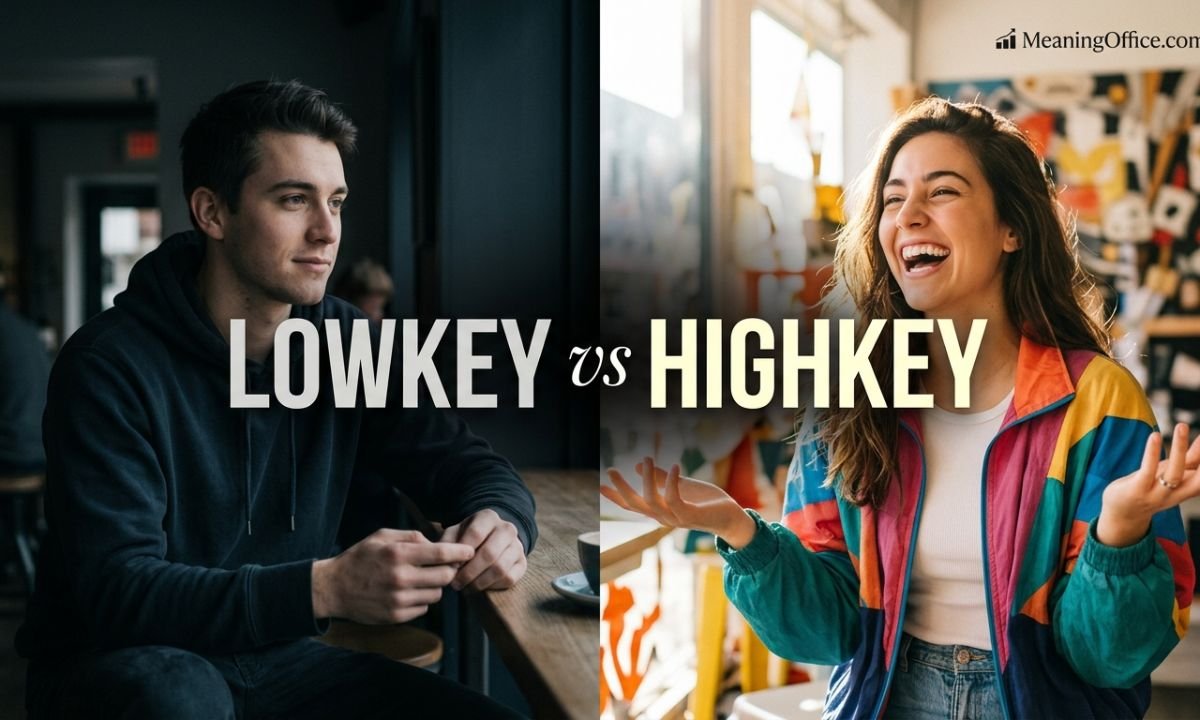
These two words sit at opposite ends of the same scale.
| Feature | Lowkey | Highkey |
|---|---|---|
| Tone | Quiet, soft | Loud, open |
| Feeling | Mild or hidden | Strong and clear |
| Example | “I lowkey want to quit.” | “I highkey hate this job.” |
| Use | Gentle confession | Bold statement |
Tip: Use lowkey when you want to sound relaxed. Use highkey when you want to sound sure.
Lowkey vs Kinda
Both words mean “a little,” but they feel different.
- Kinda only reduces the strength: “I’m kinda tired.”
- Lowkey adds a hint of secrecy or casual honesty: “I’m lowkey tired.”
Lowkey sounds a bit more personal, as if you are sharing a thought.
Lowkey vs Secretly
“Secretly” really means hidden. “Lowkey” only suggests it.
- “I secretly bought a gift” means no one knows.
- “I lowkey bought a gift” sounds light and casual, and it may not be a secret at all.
Lowkey is softer and less serious.
When Should You Avoid Using Lowkey?
Skip lowkey in these places:
- Work emails and reports. It sounds too casual.
- School essays. Teachers expect formal words.
- Serious conversations. Lowkey can make deep feelings seem small.
- Apologies. “I’m lowkey sorry” can sound like you do not mean it.
- Talking with people who may not know slang. It can confuse them.
Lowkey Abbreviation Slang
As slang shorthand, LWK follows the same rules as the full word. It is quick, but it is also easy to misread. Some people may think it stands for something else.
Use “LWK” only with friends who know slang. Everyone else gets the full word.
Polite Alternatives to Lowkey
If lowkey does not fit the moment, try one of these:
- Kind of / sort of: “I’m kind of tired.”
- A little: “I’m a little nervous.”
- Honestly: “Honestly, I think you’re right.”
- To be honest: a gentle, formal option.
- Quietly: “I’m quietly proud of you.”
- Somewhat: works in emails and school writing.
Why Do People Use Lowkey?
People like lowkey for a few simple reasons:
- It softens opinions. You can say something bold without sounding harsh.
- It feels relaxed. Texts are flat, and this word adds tone.
- It builds closeness. Sharing a “lowkey” thought feels like trust.
- It avoids pressure. You can admit a feeling without committing to it.
Impact of Lowkey in Communication
Lowkey can help a conversation feel friendly and open. It lets people share small thoughts without fear of judgment.
It can also hide the real message. If someone says “I’m lowkey upset,” they may be more than a little upset. Using lowkey can make a strong feeling seem minor.
So read the situation. If a friend says something heavy with lowkey in front of it, check in gently.
Is Lowkey Safe for Social Media?
Yes, lowkey is safe for social media. It is not a banned or harmful word. Brands, creators, and everyday users all use it.
Still, watch the sentence it sits in. A rude comment is still rude with lowkey added. And on a company page, keep the tone suited to your audience.
Read more:Plead the Fifth Meaning
Lowkey Meaning in Social Media Captions
On social media, lowkey sets a calm, understated mood. It often goes on photos of quiet moments, small wins, or simple plans.
Caption ideas:
- “Lowkey the best Sunday ever.”
- “Lowkey proud of how far I’ve come.”
- “Lowkey obsessed with this view.”
- “Lowkey vibes only.”
Low-Key Meaning on Social Media
On platforms like Instagram and TikTok, “low-key” also describes a style. A low-key post is simple, natural, and not heavily edited. A highkey post is bold, bright, and attention-grabbing. Creators use these words to describe a “quiet” or “loud” look.
Common Mistakes When Using Lowkey
Mistake 1: Treating It Like an Acronym
Some people think each letter means something. It does not. Lowkey is a word, and LWK is just a short form of it.
Mistake 2: Assuming It Always Means Secretly
Lowkey often means “kind of” or “honestly.” Read the full sentence before deciding. “Lowkey hungry” does not mean the hunger is a secret.
Mistake 3: Using It in Formal Writing
Lowkey is slang. In an email to a boss or a paper for class, choose plain words such as “somewhat” or “quietly.”
Mistake 4: Ignoring Context
The same word can sound sweet, funny, or rude. A friendly “lowkey proud of you” and a sharp “lowkey, you’re wrong” are very different. Think about who is reading and how they might feel.
FAQs
What does lowkey mean in text?
Lowkey means “a little” or “kind of.” People use it to share a feeling in a quiet way.
What does lowkey mean in slang?
In slang, lowkey means something is done in a calm or secret way. It is the opposite of highkey.
What does lowkey mean from a girl?
It usually means she feels something but does not want to say it loudly. For example, “I lowkey like this song.”
What does lowkey mean from a guy?
It means the same thing. He is sharing a soft feeling without sounding too strong.
What does lowkey like someone mean?
It means you like someone a little, but you keep it quiet. It can be a small crush.
What does lowkey miss you mean?
It means you miss someone, but you say it in a soft way. It is a gentle way to show care.
What is the opposite of lowkey?
The opposite of lowkey is highkey. Highkey means you say or show something loudly and openly.
Conclusion
Now you know what lowkey means in slang and text. It is a simple word that shows a small or quiet feeling. People use it to say “a little” or “kind of” without sounding too strong. It keeps the message soft and relaxed.
You can use lowkey in your own chats with friends. Just keep it short and natural, like in the examples above. Remember, it works best in casual texts and not in formal writing. Try it today and see how easy it feels.
2 thoughts on “Lowkey Meaning in Slang & Text: 7 Easy Examples”