

![SFS Meaning: 5 Best Uses and 3 Worst Mistakes]](https://meaningoffice.com/wp-content/uploads/2026/10/SFS-Meaning-5-Best-Uses-and-3-Worst-Mistakes.jpg)
You open Instagram and see a comment that just says “SFS?” Nothing else. If you’re wondering what it means, you’re in the right place. The SFS meaning is simple once you know the context, but using it badly can cost you followers instead of winning them.
This guide covers what SFS means in text, how it works on each platform, when it helps, and where people go wrong.
What Does SFS Mean?
Simple Definition
SFS most commonly stands for “Shoutout For Shoutout.” It is a trade: you promote someone’s account, and they promote yours. Both sides get exposure to the other’s audience.
In a few cases it can also mean “Snap For Snap” or “Spam For Spam.” More on those below.
The Origin of SFS
SFS grew out of follow-for-follow and like-for-like culture on early Instagram. Creators with small audiences realized they could borrow reach from each other. Typing out “shoutout for shoutout” in every caption and comment was slow, so people shortened it to three letters.
There is no single “inventor” of the term. It spread the way most slang does: through repeated use in comments, captions and DMs.
Also read this Meaning:FOMO Meaning in Chat: 7 Shocking Facts
How SFS Works (Step-by-Step)
- Someone offers or asks. One user posts “SFS?” in a comment, DM or caption.
- The other user agrees. A quick “yes” or “deal” is enough.
- Both post a shoutout. This could be a story mention, a post tag or a video shout.
- Both check the result. Each person confirms the other kept their end.
Example
Mia: Love your content! SFS?
Jordan: Sure! I’ll post you on my story today.
Mia: Perfect, I’ll do the same.
Different Meanings of SFS (Context Matters)
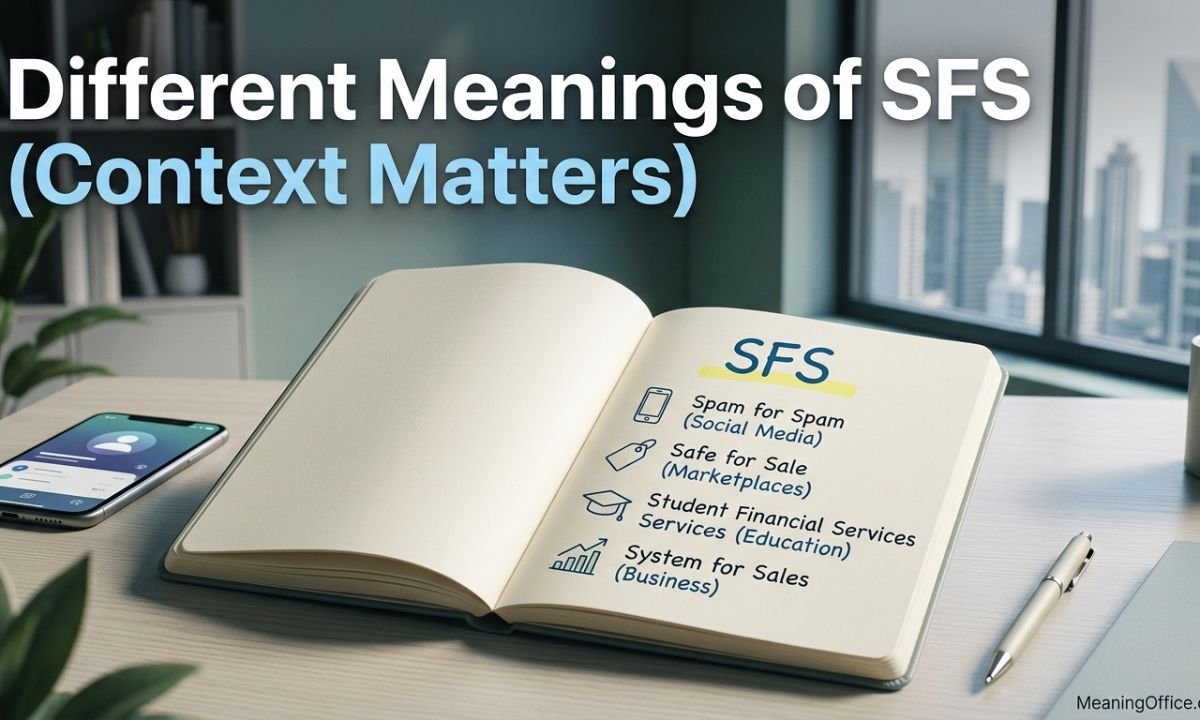
The same three letters can point to different things. Here is a quick comparison.
| Meaning | Full Form | Where You’ll See It | How Common |
|---|---|---|---|
| SFS | Shoutout For Shoutout | Instagram, TikTok, YouTube | Most common |
| SFS | Snap For Snap | Snapchat | Common |
| SFS | Spam For Spam | Instagram, group chats | Less common |
1. SFS = Shoutout For Shoutout (Most Common)
This is the default reading. If the message mentions posts, stories, followers or your page, it almost certainly means shoutout for shoutout.
2. SFS = Snap For Snap
On Snapchat, it means you send a snap and the other person sends one back. People use it to keep streaks alive or start a conversation.
3. SFS = Spam For Spam (Less Common)
This one means you flood someone’s content with likes or comments, and they do the same for you. It’s rare, and most people find it annoying rather than helpful.
Outside social media, SFS can stand for unrelated things such as “Student Financial Services” or “Special Forces Support.” If the chat has nothing to do with posting or followers, check the setting before assuming.
SFS Meaning on Different Platforms

SFS on Instagram
Instagram is where SFS lives. You’ll see it in comment sections, bios, story captions and DMs. Here it nearly always means a mutual shoutout through stories, posts or Reels tags.
SFS on Snapchat
On Snapchat, SFS usually means “Snap For Snap.” Some creators also use it to swap Story shoutouts, so look at who is asking and what they want.
SFS on TikTok
TikTok users apply it in comments and duets to swap shoutouts, often through a video mention or a pinned comment. Because the feed is driven by the algorithm, results are less predictable than on Instagram.
| Platform | Usual Meaning | Typical Format |
|---|---|---|
| Shoutout For Shoutout | Story mention, post tag | |
| Snapchat | Snap For Snap | Streak or direct snap |
| TikTok | Shoutout For Shoutout | Video mention, comment |
Is SFS Still Effective in 2026?

Partly. SFS can still get you a small burst of attention, but it is no longer the growth shortcut it once was. Platforms now reward watch time, saves and real interaction over raw follower counts.
When SFS Works Well
- Both accounts share a similar niche and audience.
- Follower counts are roughly equal.
- The shoutout feels personal, not copy-pasted.
- You do it occasionally, not every day.
When SFS Doesn’t Work
- The accounts have nothing in common.
- One side has a large audience and the other has a tiny one.
- Followers are bought or inactive.
- You post shoutouts so often that your feed reads like an ad board.
Pros and Cons of SFS
Pros
- Free promotion. No ad budget needed.
- Quick networking. You meet creators in your niche.
- Potential follower boost. Especially with a well-matched partner.
- Easy to try. One message starts it.
Cons
- Low-quality followers. Some people follow only to receive the favor.
- Uneven effort. One side may skip their part.
- Spam perception. Heavy use can make your page look desperate.
- Possible reach limits. Platforms discourage spammy engagement tactics and can reduce visibility for accounts that lean on them.
How to Do SFS the Right Way
Treat SFS as a collaboration, not a transaction. The tips below turn a throwaway trade into something that actually helps.
5 Best Uses of SFS
- Pair up with a creator in your niche. A baking page promoting another baking page gets relevant followers, not random ones.
- Match audience size. A fair swap beats one where someone gives far more than they get.
- Write a personal shoutout. Say why you like their content. “Go follow this account” is forgettable. “She posts the best five-minute dinner ideas” gets clicks.
- Use it to launch something new. A new page, product or series benefits most from a small boost in the first week.
- Turn it into a real relationship. The best SFS partners become repeat collaborators who comment, share and support each other long term.
3 Worst SFS Mistakes to Avoid
- Asking everyone, everywhere. Mass-sending “SFS?” to dozens of strangers looks like spam and rarely gets replies.
- Not keeping your end of the deal. If you promise a shoutout and skip it, you lose trust fast, and people talk.
- Chasing numbers over quality. Gaining 500 followers who never engage can hurt your engagement rate more than it helps.
Quick tip: Agree on the details first, including what you’ll post, when, and for how long. A clear message prevents most SFS disputes.
Alternatives to SFS
If SFS feels spammy or ineffective, try these options instead:
- Collab posts. Instagram’s Collab feature shows one post on both accounts.
- Duets and stitches. On TikTok, these put you in front of another creator’s audience naturally.
- Giveaway partnerships. Two accounts co-host a prize, and both gain followers.
- Genuine comments. Thoughtful replies on posts in your niche attract profile visits.
- Paid promotion. If you have a budget, ads give you more control than shoutout swaps.
Common Misunderstandings About SFS

“SFS guarantees followers.” It doesn’t. It gives exposure, and exposure only becomes followers if your content is worth following.
“SFS means the same everywhere.” Context matters. On Snapchat it often means snap for snap, and in other settings it can be unrelated to social media entirely.
“The bigger the account, the better the swap.” Not always. A smaller, engaged audience often converts better than a large, passive one.
“Anyone can do SFS safely.” Be careful with strangers. Avoid sharing personal details, and never click suspicious links sent as part of an “SFS deal.”
Also read this Meaning:WTM Meaning in Text: 7 Important Facts
Frequently Asked Questions (FAQs)
What does SFS mean in text?
In most chats, SFS means “Shoutout For Shoutout,” a trade where two people promote each other’s accounts.
What does SFS mean in text messages?
In text messages, it usually points to a mutual favor: you do something for me, I do the same for you. On Snapchat it can mean “Snap For Snap.”
What does SFS mean on Instagram?
On Instagram, it means you and another user agree to post a shoutout for each other, usually in stories or posts.
What does SFS mean on Snapchat?
It typically means “Snap For Snap,” where each person sends a snap in return for one received.
Is SFS the same as follow for follow?
No. SFS is about promoting each other through shoutouts, while follow for follow is simply trading follows.
Is SFS safe to use?
It is generally safe if you stick to accounts you trust. Never share passwords or personal information as part of a swap.
Does SFS still work?
It can help in small doses, especially between similar niche accounts. As a long-term growth plan, it’s weak.
Is “Spam For Spam” a real meaning?
Yes, but it’s uncommon. Most people mean “Shoutout For Shoutout” when they type SFS.
Conclusion
The SFS meaning is easy: most of the time it stands for “Shoutout For Shoutout,” with “Snap For Snap” and “Spam For Spam” as less common variants. It remains a handy way to meet other creators and get a small visibility lift.
Use it with intention. Pick partners in your niche, keep your promises, write real shoutouts, and don’t let it replace good content. Done that way, SFS is a useful tool. Done carelessly, it just makes your page look like spam.
1 thought on “SFS Meaning: 5 Best Uses and 3 Worst Mistakes”